


The administration recently announced a new policy initiative involving reciprocal tariffs, intended to address ongoing trade imbalances. The announcement, delivered during a press event at the White House Rose Garden, introduced a baseline tariff rate of at least 10% on a broad range of imported goods, with potential discounts based on trading partner practices.
To understand the broader implications of this policy, it's helpful to clarify the concept of a trade deficit. A trade deficit occurs when a country imports more goods and services than it exports. Conversely, a trade surplus arises when a country exports more than it imports. These trade balances are often misunderstood, and are sometimes incorrectly equated with budget deficits, which refer to a government spending more than it collects in revenue. While both involve imbalances, they are fundamentally different in cause and impact.
The methodology behind the new tariff rates has raised questions. The administration cited a combination of factors—such as existing tariffs on U.S. goods, value-added taxes, regulations, and other non-tariff barriers—to determine the appropriate reciprocal rate for each country. However, in practice, the calculations appear to be based solely on goods traded, excluding services, which make up a significant portion of the U.S. economy. Simplifying these complex trade relationships into a single rate based on goods surpluses may overlook important nuances in global commerce.
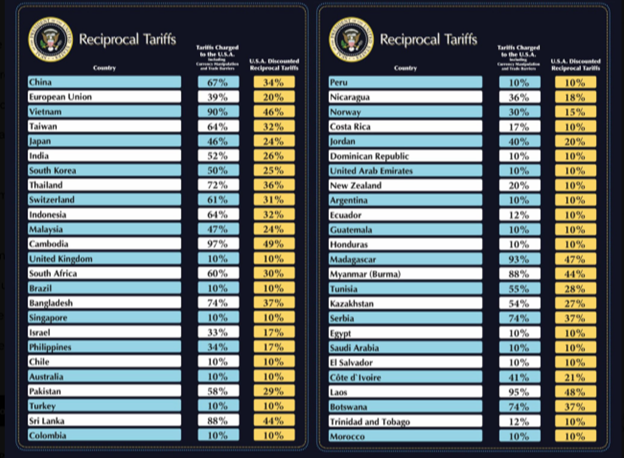
Another key assumption underpinning the policy is that trade balances should be even between countries. However, in reality, trade imbalances often result from structural economic factors, consumer preferences, and comparative advantages. Economic theory generally does not suggest that trade must balance bilaterally, and efforts to enforce symmetry may not align with established economic models.
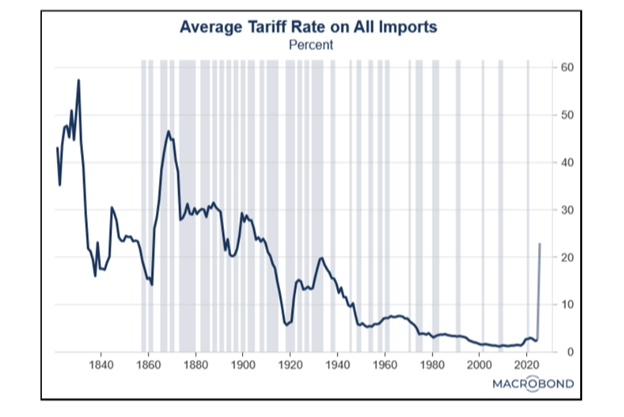
According to estimates from MacroBond, if fully implemented, the average effective tariff rate under this policy could exceed 22%, a level not seen since the early 20th century. This could have wide-ranging implications, including higher prices for U.S. consumers and potential changes in global trade dynamics.
Potential Political Outcomes
The introduction of reciprocal tariffs may carry several political consequences, both domestically and internationally:
· Domestic Support and Opposition: Supporters may view the policy as a strong stance on economic sovereignty and fairness in international trade, potentially bolstering support among constituents who favor protectionist measures. On the other hand, critics may raise concerns about higher consumer costs and potential retaliation from trade partners, which could become a point of debate in upcoming elections.
· Congressional Action: Depending on the economic impact and public response, Congress may take up legislative efforts to either support, modify, or challenge aspects of the tariff policy. This could lead to broader discussions about trade authority and the executive branch’s role in setting tariff rates.
· Trade Partner Responses: Some countries may seek negotiation to reduce or avoid the reciprocal tariffs, while others could respond with their own tariffs or trade barriers. This may influence diplomatic relations and future trade agreements.
· Impact on Future Policy: The outcomes of this tariff policy—whether successful or problematic—could shape future U.S. trade strategies, influencing how future administrations approach trade imbalances and global economic partnerships.
As with any significant economic policy, the long-term political effects will depend on measurable outcomes, public perception, and how both domestic and international stakeholders respond in the months ahead.
The opinions voiced in this material are for general information only and are not intended to provide specific advice or recommendations for any individual. All performance referenced is historical and is no guarantee of future results. All indices are unmanaged and may not be invested into directly.
The economic forecasts set forth in this material may not develop as predicted and there can be no guarantee that strategies promoted will be successful.