


Those of us who live in the southwest know what drought conditions look like. And every so often we’ll go through a long stretch, sometimes months and months, without rain. And those periods are getting more frequent. The business cycle over the last two decades has been a bit like that when it comes to recessions. And in the last two years even the most reliable indicators that have signaled for recession just haven’t been, well, reliable.
So, what’s happening with the business cycle?
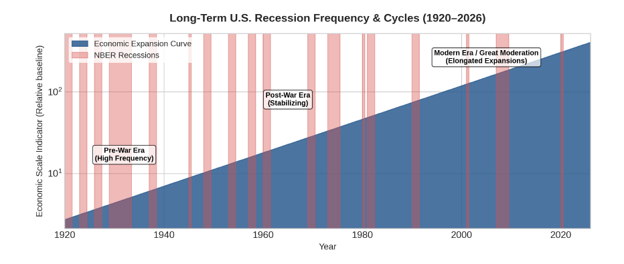
A basic analysis, illustrated in the chart above going back over 100 years, tells us that the economy has changed as we have gone from the pre-war industrial age, where the main business activities were in heavy industry and manufacturing, to the post-war modern era, sometimes referred to as the great moderation where technology, computers and the digital economy stabilized the business cycle and made it much longer. Expansions now average 8 to 11 or more years as opposed to 3 to 5 years in the prior era, according to data from the National Bureau of Economic Research.
But since the last recession in 2020, one of the shortest on record brought on by the Covid-19 pandemic, it seems that there is another era beginning with the advent of AI and a new industrial age that was started by the adoption of the internet in virtually every business activity. These prolonged expansion cycles would seem to be a feature of the new era and they have definite consequences for investors.
Historically, recessions have been the method by which the economy weeded out weaker economic actors. As an economy overheated and capital was misallocated or used inefficiently, a recession would reset the field. The stronger businesses would survive and those who found themselves on the street would get back up, brush themselves off and either find a place in a thriving business or innovate and start something new.
However, since the great financial crisis of ’08-’09, policy makers have begun to take extraordinary steps to prevent the worst consequences of a deep recession or depression. These include three policy arenas; monetary, fiscal and regulatory. On the monetary side, the fed has been seen taking rates to zero and in some parts of the world, central banks even experimented with negative rates. Fiscal policy has been especially generous at times with bailouts, loans and even checks in the mail during the pandemic. And regulations across the board have come into play that were unthinkable prior to the year 2000. Throw an AI revolution into this context and it is no wonder economies around the world seem to be so resilient to full blown recession, especially here in the US.
What is an investor to do in a world where recessions are few and far between? This is likely why the buy the dip mentality has become so prevalent. There just haven’t been many deep market selloffs where savvy investors know big opportunities lie. Sitting on a big cash position waiting for a 40%-off sale has been a losing proposition of late. For investors, this means maintaining a well-balanced portfolio and watching for rolling opportunities in sectors and asset classes have become even more important in this environment.
And for younger people, building wealth, saving for household formation, finding a first home to buy, all have become big challenges. Gen Z has the highest net worth of any generation relative to their current stage but also the lowest home ownership percentage.
As the economy changes, and the pace of change speeds up, it is even more important to have and maintain a long-term strategy. Know that we are here to help.
And know, It will rain again.
The opinions voiced in this material are for general information only and are not intended to provide specific advice or recommendations for any individual. All performance referenced is historical and is no guarantee of future results. All indices are unmanaged and may not be invested into directly.
The economic forecasts set forth in this material may not develop as predicted and there can be no guarantee that strategies promoted will be successful.